With our state test approaching we are reviewing concepts from earlier in the year to make sure we’ve got it! Fraction Boot Camp was one way our class prepared this year. Here’s how Fraction Boot Camp worked in my classroom:
STEP 1–Write fraction standards on chart paper, set class goals, and plan a class celebration. Our class decided on 85% for each assessment as our goal and that we would celebrate with a picnic outside on a nice weather day when we met our goal.
STEP 2–Review each skill with a mini-lesson, have students complete a few ‘number problems’ to make sure they understand, then give partner time to work some word problems while meeting with a small group who needs a little extra help. Number problems are simply working with the numbers. I need to know that my students understand equivalent fractions with mixed numbers and improper fractions prior to giving them lots of word problems to solve! Check out CC Sheets. It is one of my favorites for number only problems. Because I teach the TEKS and not CC, I search by skill rather than standard and grade level.
STEP 3– Assess and report class averages on the chart. The kids love to see their progress posted in the classroom.
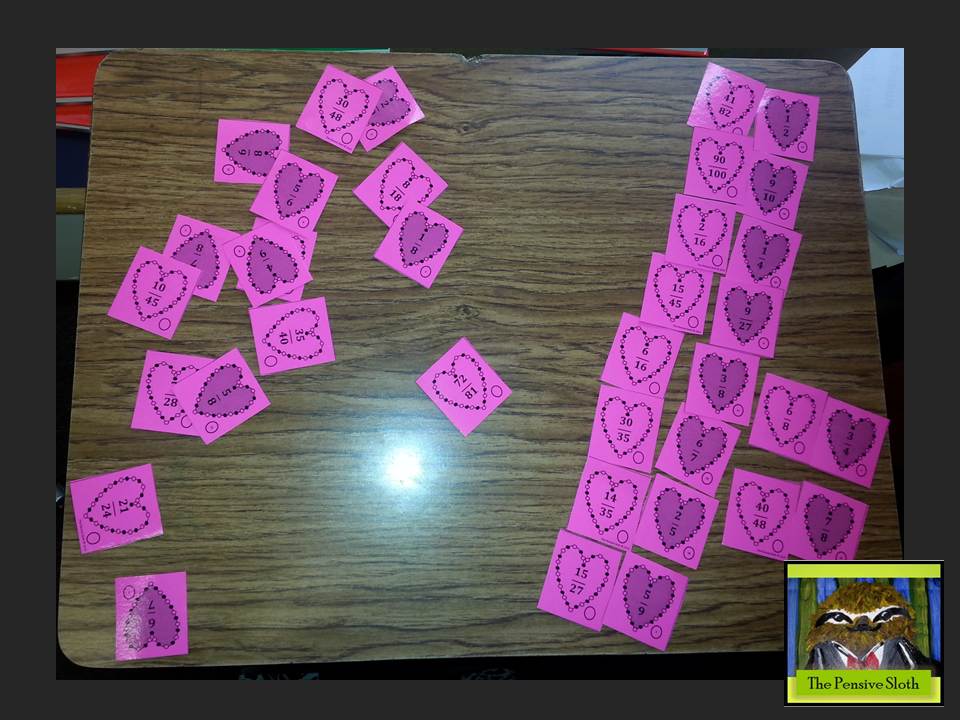
Valentine’s Day fractions matching game for equivalent fractions, including mixed numbers and improper fractions
This year’s Fraction Boot Camp was a big success! Our class averages were in the 90s each time and we got to celebrate with a picnic outside. We also played some fraction games and you can find those here! There is a winter set, Valentine’s Day set, and St. Patrick’s Day shamrock set.
St. Patrick’s Day/Shamrock Theme Game–Students sort fractions by finding equivalent fractions and matching them to the simplified (or reduced) fraction.
Fun heart themed fractions games to help students practice matching equivalent fractions, including improper fractions and mixed numbers.
Fun winter-themed game for students to practice equivalent fractions, including improper fractions and mixed numbers!
I read a blog post earlier this week by Common Core Galore and More! and it was hilarious. You should read it. It gives a very honest look at one teacher’s perspective of centers from the “zoo cage.” It was as though she took a photo of my classroom when I taught first grade and wrote about it. Spot on. Now that I’m an intermediate grade teacher, things aren’t much different during centers. We call them stations now.
So last week, I left the zoo cage.
If you are wondering what the zoo cage is, it is the teacher’s seat at the small group table, tucked away to the side of the room where much maneuvering is required to get out. The problem is that the kids know you are trapped, and while the cat’s away, the mice will play…
Last week, quite by accident, things changed in my room and I escaped! In all the hustle and bustle of teaching and meetings and trainings and tutoring and paperwork and the various other minutia that makes up a large percentage of a teacher’s job, my small group table has become a pile of projects and it just wasn’t suitable for children. But, this was no excuse not to meet with my kiddos who needed a refresher on multiplying and dividing with decimals. So, I moved to the rug. With clipboards in hand, my students gathered eagerly (well, obediently) around my easel and all was right with the world! Things weren’t perfect, but I certainly had a better position in the room. I could see more, get up and around faster, and interact more openly with the others who were working on tech projects.
It has been over a week now, and I plan to continue my experiment and let you know how it goes. Happy teaching!
Teach small groups somewhere other than small group table? Challenge accepted!
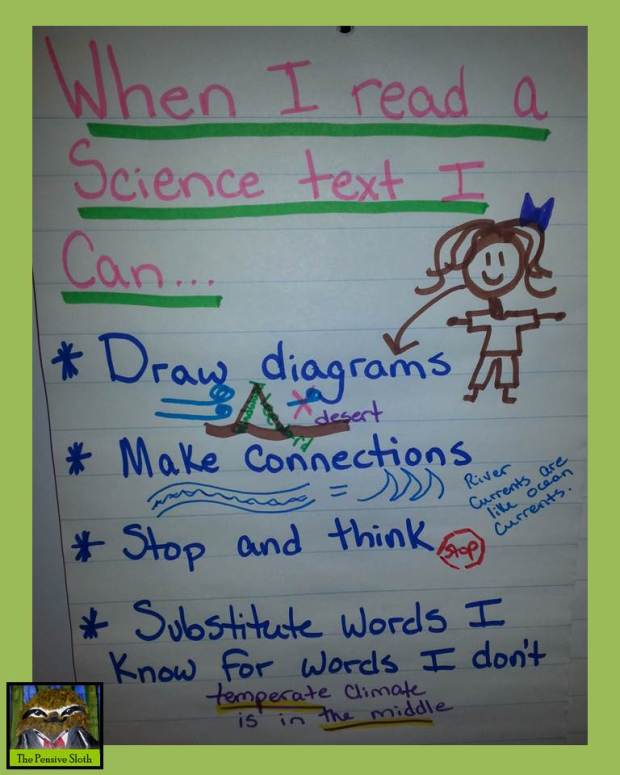
While reading a short text on climate zones and the mountain effect, my kiddos struggled with some of the ideas that were being presented. I decided that it was a perfect time for a reading strategy lesson!
While reading, I modeled and had my kids participate in a few things:
1–Drawing a picture to show the mountain effect, labeling the windward and leeward sides and which side would be dry
2–Substituting the words ‘in the middle’ for the word temperate to help kids understand temperate climates
3–Discussing the connection between river currents (that students were familiar with) and ocean currents
I found this really nifty song on Pinterest, though I don’t remember where so that I can give credit! But, I thought I would share it. It has helped my kiddos a lot with remembering what the ‘landmarks’ represent.
Hey diddle diddle
The median is the middle
You add and divide for the mean
The mode is the one that appears the most
And the range is the difference between
Math anchor chart for landmarks–mean, median, mode, range
Also, I discovered the greatest site for math practice worksheets. If you are looking for basic problems, like those not all dressed up in word problems, so that you can know your kiddos have mastered a skill, you’ve got to try THIS SITE. I’m a Texas teacher and do not use Common Core, so if you are in Texas, don’t search by standard or grade level. Just look at the skill because it is taught in different grades. I used the Mean, Median, Mode, Range set with my 5th graders even though it is listed as a 6th grade set. The great part about this site is that all of the sheets are organized the same way, they come with answer keys, and there are 10 versions for each skill! This is perfect for small groups because if the student didn’t understand whole group, you can re-teach in small group and have something for them to practice. Love it! It must have been created or organized by a teacher because it is super classroom friendly. Happy teaching!
3 Ways to Use YouTube In Your Intermediate Classroom in 2014
NOTE—The songs are totally cheesy! I know this and so do my students. Just go with it. They’ll love it. Sometimes to remove the “I’m too cool to enjoy this” factor I tell them that I have found THE cheesiest song about the planets (or whatever you are teaching) in the history of mankind. I play the song and they usually agree. But, they also ask to hear it again!
1—Play Funky Songs & Raps in Class
Do you want your students to go home and study, go home and share what they have learned, or at least think about what you’ve done in class that day? Consider using a song or rap from YouTube related to the concept you are teaching.
Why it works– Many kids have access to YouTube from smartphones, tablets, pcs, home computers, and even streamed through a TV! All it takes is playing the song a few times in your classroom to get them hooked. There’s something about music that makes learning memorable. I usually play the songs while we transition from one subject to the next or as a reward while we pack up at the end of the day. I then add the link on my class webpage and let the magic happen! Your students will most likely spend some time online when they go home and may just revisit the video you shared in class.
2—Use a Math Strategy Video to Introduce or Review
The brain loves novelty and variety. Want to make your lesson a little more engaging and unique? Find a video clip of what you are teaching that day in math to start your lesson or review.
Why it works—Today’s students are tuned-in to technology and a 2-3 minute clip at some point in your lesson adds a little variety. Not only do they get to see a strategy twice (once from you and once from the video), they are seeing it from someone else. Plus, adding the link to your site gives students something to refer to should they need a refresher or if they were absent. When I introduced fractions recently, this was really helpful! I’ve even used a REALLY good YouTube video as my whole lesson before…but that’s for another post and is a little harder to do effectively.
*Equivalent Fractions (This one is cool because it explains WHY multiplying a fraction by 4/4 to get an equivalent fraction still doesn’t change the value of the fraction.)
3—This one is just for fun…Dance Breaks!
Sometimes we just need a little break during the day, especially if you are self-contained like me. Early childhood teachers know this and frequently use music and movement with Dr. Jean and Greg and Steve songs. Our older students love to move as well and they REALLY love listening to their favorite tunes. Now, I use dance breaks as a reward quite often, and it works great if you use Whole Brain Teaching’s Scoreboard in your classroom, so consider using a “Just Dance” type video to add some fun and give your kiddos a chance to get their wiggles out!
Why it works–It works because it is fun.Students need to move. Teachers need to move. It’s healthy. It brings oxygen to the brain. It wakes you up. And much more! If you use it as a whole class reward, students also have something to look forward to when they finish an activity and have worked hard, followed directions, and paid attention as a class. I choose videos that show the steps rather than just listening to a song and dancing along for two reasons. First, using a dance video that shows the steps encourages your somewhat reserved students to participate because they can just follow along and not have to invent their own moves. Second, if you have students whose dance moves might be a little too…um… ‘inappropriate for school,’ you can tell them to stick with what is on the screen. Don’t worry if not everyone participates. I call it the wildfire effect, but each time you do a dance break, a few more kiddos join in! And those that done still enjoy listening to a popular tune and watching their friends get groovy!
CAUTION– You must preview the videos from home before sharing them with your class. Let me say that again. Previewing the videos from home and really listening to the lyrics will keep you out of trouble. There are dance videos specifically for kids, but my students said “We’re not babies” when I tried to use some of those. They prefer the more popular songs that they hear on the radio, so you have to watch the WHOLE video and listen to ALL the lyrics at home before you use a song in the classroom. If not, well…not all music on the radio is classroom appropriate!
3 ways The Reading Zone, by Nancie Atwell, has changed my classroom
My principal recommended Nancie Atwell’s book, The Reading Zone, at a meeting early in the year and I finally got around to checking it out. I’d heard of it before, and that it was great, but the recommendation was just the encouragement I needed! I have to say that it is one of the few teacher books I have read cover to cover. As a habitual skimmer, I usually just read the parts that fit my classroom, but all of this stuff was relevant, and Atwell’s honesty is refreshing. Here are three things I am now doing consistently that have changed my classroom.
FIRST, I am giving my kiddos time to get into ‘the zone.’ This means that we read every day. For 30 minutes. Every day. I don’t skip independent reading to make up teaching time because there is an assembly or field trip. It is too important. Atwell stresses the importance of voluminous reading, and in the 5 short weeks I have devoted to daily reading, my students have already been lost in books for 750 minutes and they are behaving like readers. It wasn’t instant reading zone magic. I started the year with great intentions, but I wasn’t consistent with reading time and my kids weren’t living as readers. They weren’t prepared with books to read because they weren’t sure they would have time in class to do so. Despite the ‘Independent Reading’ anchor chart on my wall, they still asked to go to the nurse or library or restroom or chatted or got up for tissues or to switch books or drew pictures… They don’t do this anymore because they come to class with books they plan to read and THEY hold this time to be as precious as I do. It took about 2 weeks of consistent independent reading time before this happened, but you can hear a pin drop in my room while we are all reading, and an occasional giggle from someone who is reading something silly. The routine is set and it takes about one minute for everyone to settle down to read, and then the magic happens.
NOOO! You mean it is time to stop reading?
SECOND, my students and I are really talking about books. Atwell does a great job of explaining the conferences she has with students, but I didn’t start out conferencing during reading time. I started out reading independently with my students. First, I didn’t want to circulate about the room and disturb anyone until I knew my kiddos were able to dive into a book and ignore my moving about. The other reason I started reading independently during this time is because I wanted my kids to see what it looked like to be in the zone. I sat in a chair and read the entire time. I wanted them to see that I thought reading was important, more important than grading papers or setting up for science. It was important to spend time lost in a book. After a few weeks, I started walking around and conferencing with my students. Atwell does a great job explaining the reading conference. It’s not fancy, just a quick discussion with each reader. Some discussions are longer than others, but most are drive-thru chats and I’ve learned so much about what my kids are reading and why. I have learned who has books of their own at home, that my class really loves series books, and that they talk to each other about what they are reading. In fact, this is how most of them decide what to read next.
In the book, “The Reading Zone,” Atwell has a page of reading conference starters. I carry a copy on my clipboard as I chat with my kiddos. It is very well organized!
THIRD, we have started weekly book talks. Basically, a few readers advertise their books to the class. Students who have a book they think others should read spend a few minutes telling us about it, without giving too much away. A few kids ask questions about who the author is, if we have the book in our library, and if they can have the book next! The speaker shows us the cover on the projector so that anyone who wishes can add it to their ‘someday reading lists.’ It is great fun and is a super easy way to encourage readers.
I plan to add reading letter-essays to my classroom like Atwell uses to converse with her readers more formally, but I’m taking things one step at a time.
If you read but ONE book this semester, I suggest this one. Go forth and inspire your readers!
I’ve been working hard to add more ‘color’ to the charts my kiddos and I make. My students have really responded to this. We discuss, all the time, how the brain thinks in pictures and that illustrating and diagram-ing in science, social studies, and EVERYTHING can really help learning ‘stick,’ so it was only a matter of time before I had to start drawing, too! While my artistic skills leave much to be desired, it has been a bonding experience for my students and I. They know I am taking a risk every time I try to draw, and we laugh together at the results, someone usually offers a stretched compliment, and it makes for a memorable experience. Here are a few charts we’ve made recently.
Here is “What we THINK we know about the Earth, Moon, and Sun.” (below)
5th Grade Food Chain–I always label my pictures so they are easier to understand! (below)
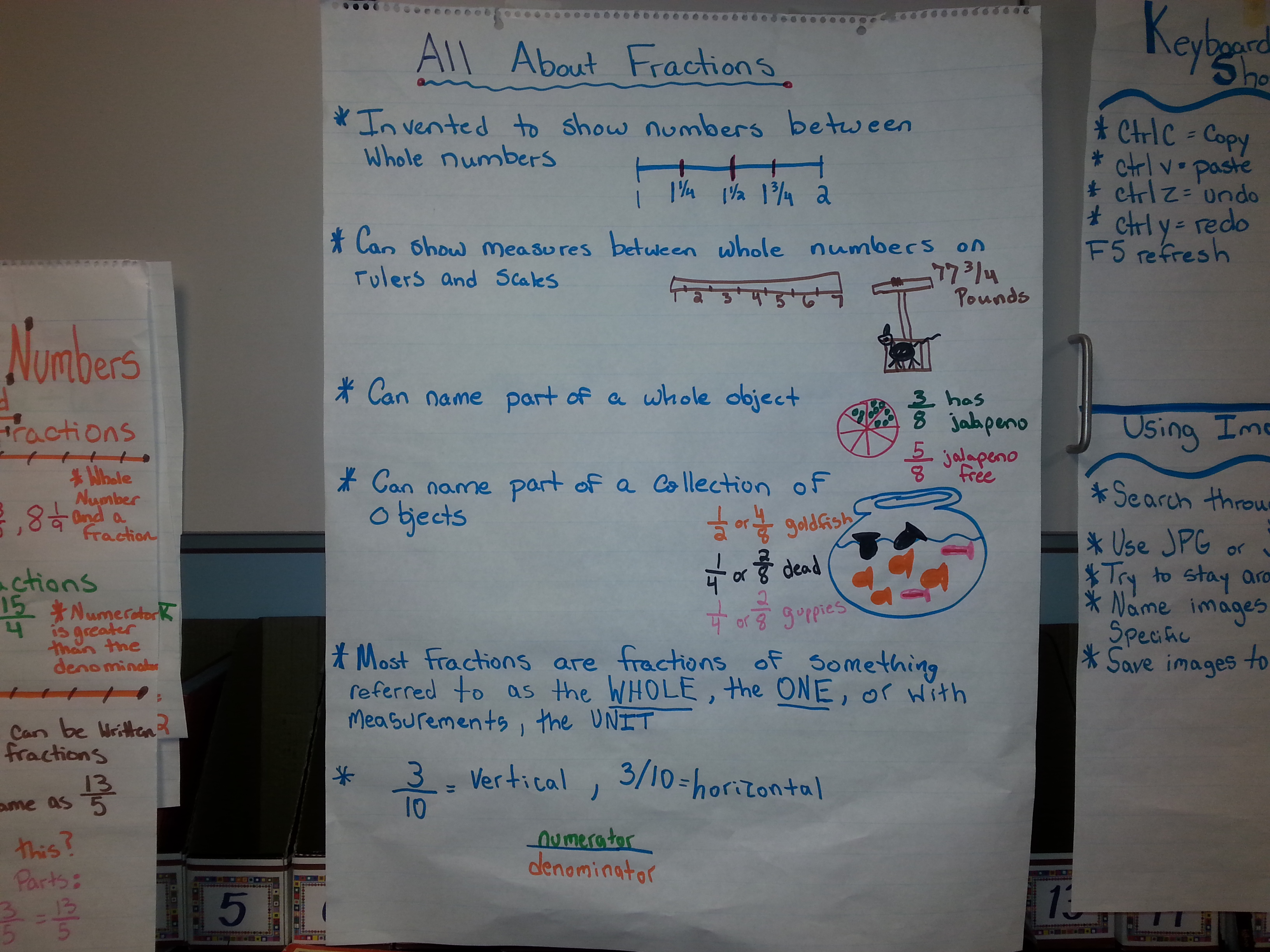
Before we delved into fractions, we discussed what they were and how they are used. (below)










 The Pensive Sloth